Research & Development Projects
A collection of my work spanning VR/AR research, human perception studies, interactive experiences, and game development
Pupil Swim's Perceptual Power
Vision, Audition, & Action in Space & Time (VAAST) Lab
This research investigates the effect of optical distortions on human perception and action within VR HMDs. This project employs the use of previously established and trusted methodologies to unpack how considerations for design, optical architecture, and manufacturing impact end user experience and perception of virtual environments. Key questions: (1) Can we quantify spatial distortions from an image in an HMD when viewed outside of the eyebox? (2) Is distortion induced from pupil swim or mismatched IPD perceptible by human observers? (3) Does distortion from pupil swim or mismatched IPD alter actions in ecological tasks?
Conference Posters
Effects of Pupil Swim on Eye-Tracking in VR — ECEM 2024 · SR Research Best Poster Award
Does Eye Position Alter Depth Perception? — IEEE ISMAR 2025
VR Research Browser
Personal Project
A searchable database of 2,400+ VR/AR perception papers I built to accelerate literature reviews and related work discovery. Papers are tagged by study type, equipment, framework, independent and dependent variables, and key findings — making it possible to search by methodology, headset, or research question rather than just title or author. Features include BibTeX/CSV export, an author co-authorship network, a globe view of institutional collaborations, a side-by-side paper comparison tool, and an AI Research Assistant powered by Claude for natural language queries across the corpus.
I have an additional ~2,000 papers queued to add, but continuing to expand and maintain the database requires funding. If you find the tool useful, any donation through Ko-fi goes directly toward adding more studies. As a thank-you, donors who request it will have all of their publications added to the database. I also plan to expand into additional fields and segment the corpus into genres to reduce loading overhead. If you have an extensive or master BibTeX file you'd be willing to share, I'd greatly appreciate you sending it via the form below — it would go a long way toward making this a more comprehensive resource for the community.
Share Your BibTeX
Attach a .bib file and leave a message — I'll get back to you.
Kids in VR
Vision, Audition, & Action in Space & Time (VAAST) Lab
Kids use VR too! This series of experiments focuses on affordance perception and calibration in children compared to adults. The projects I led focused on reaching up, reaching out, stepping up, and stepping out within the real and virtual worlds. This research examines how children's developing perceptual systems interact with virtual environments differently than adults.
Teaching & Outreach
Kahlert School of Computing
Alongside my research, I develop and deliver lectures that bridge computer science and cognitive science for undergraduate students. These mini-lectures ground abstract CS concepts in real empirical research, using my own lab work as a teaching vehicle. Topics range from data bias and experimental methodology to the perceptual science behind VR systems — making rigorous research accessible to early-career students.
Multisensory Integration in VR
Vision, Audition, & Action in Space & Time (VAAST) Lab
Navigation is a cooperative task across all of our senses. This series of experiments focuses on how we integrate these senses together. To accomplish this, I developed ways to impair vision within a VR headset and implement methodologies to pull apart how we rely on our senses. We attack this problem in two ways: disrupting or manipulating one sense to discover its effect, and measuring the acuity of each sense by isolating cues to a particular modality.
Conference Posters
Multisensory Integration — CRaNE 2025
Sensory Integration for Balance & Navigation After Concussion — RehabWeek 2025
Concussions, Sensory Integration & Spatial Updating — UROP 2024
Near Space Action Capability Perception in AR & VR
Vision, Audition, & Action in Space & Time (VAAST) Lab
Perceiving what actions are possible in the near environment — whether you can reach an object, pass through a doorway, or step across a gap — depends critically on how well you understand the relationship between your body and the surrounding space. This series of projects investigates how people judge their action capabilities (affordances) in VR and AR, and whether those judgments can be trained and transferred across realities.
A central thread across this work is calibration: providing perceptual-motor feedback about the outcome of an action (e.g., whether a virtual collision occurred while passing through a doorway with an extended object) reliably brings affordance judgments closer to true ability. Crucially, calibration achieved in VR transfers to AR even when the environments differ substantially in visual fidelity and body representation — supporting the use of immersive virtual training for tasks ultimately performed in mixed reality contexts. A parallel line of work examined reaching across realities (VR, AR, and the real world) using the integrated Leap Motion in a Varjo XR-3, comparing how the presence of a virtual versus physical hand affects near-space distance estimates.
Conference Posters & Presentations
Calibration of Passability Judgments in VR Transfers to AR — IEEE VR 2023
Aperture Perception in AR & VR — Psychonomics 2022
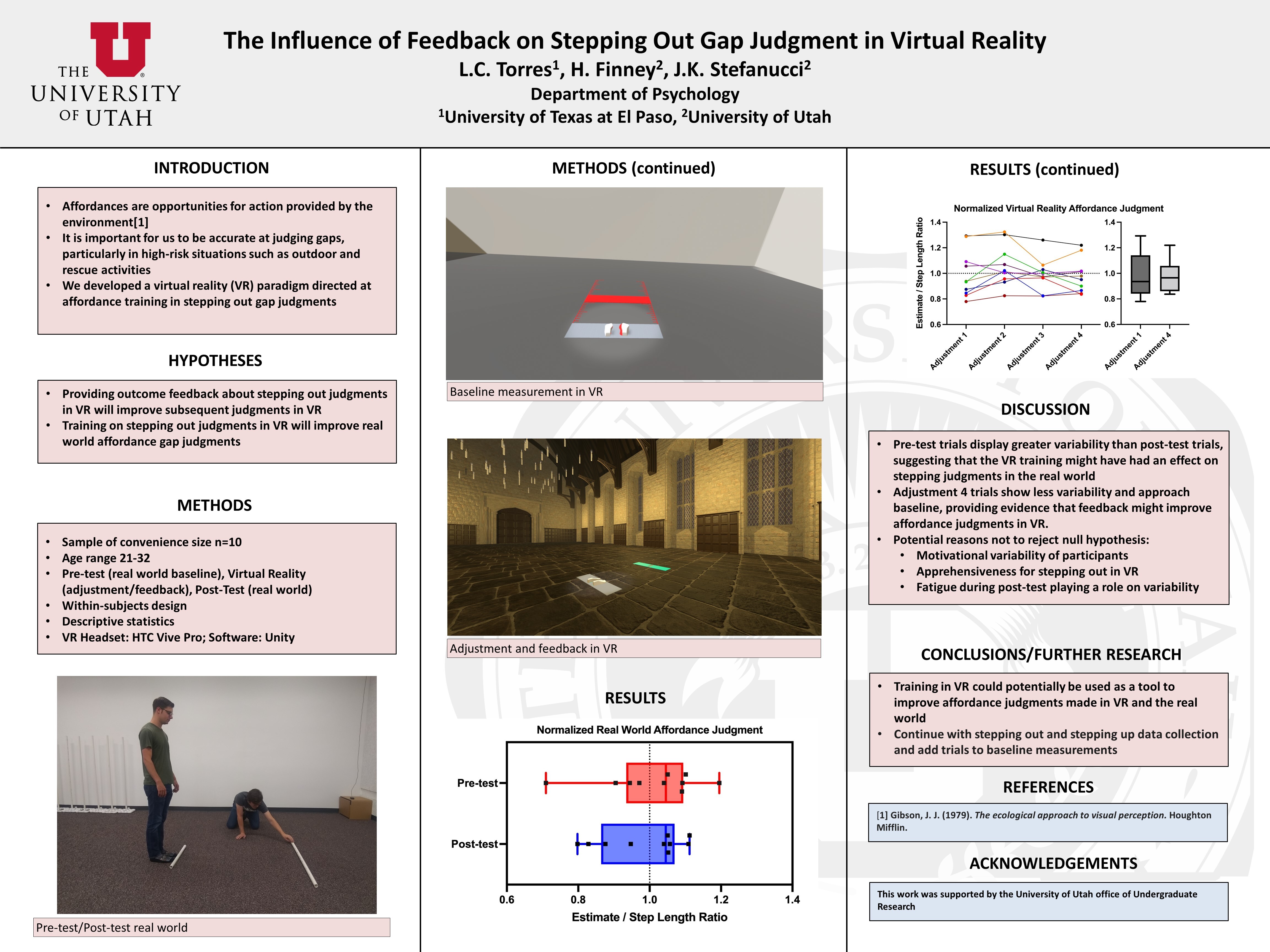
Near Space Perception in AR & VR — Conference Poster
Perceptual Bias in VR
Vision, Audition, & Action in Space & Time (VAAST) Lab
This precursor to my dissertation is a proof of concept of how to measure perceived distortion of users in a VR headset induced by a lens's prism effect.
Nagual - VR Puzzle Game
Class Project
This VR game was completed as a group project at the University of Utah. I led VR development with an emphasis on a shape-shifting mechanic similar to a world in miniature approach to locomotion where the user would shrink in size while maintaining an IPD relative to their original height. This would allow the user to access parts of puzzles otherwise not accessible.
Slap with Leap Motion
High Fidelity Virtual Environments (HI5) Lab
Slap is a VR experience created for the Imagine the Possibilities Career Expo to expose young students to how VR can be used to teach abstract concepts such as atomic structure in a fun and stimulating way. This demo is designed for a user to be seated at a table to have tactile feedback when interacting with the environment. The project requires SteamVR, Unity3D, and a Leap Motion.
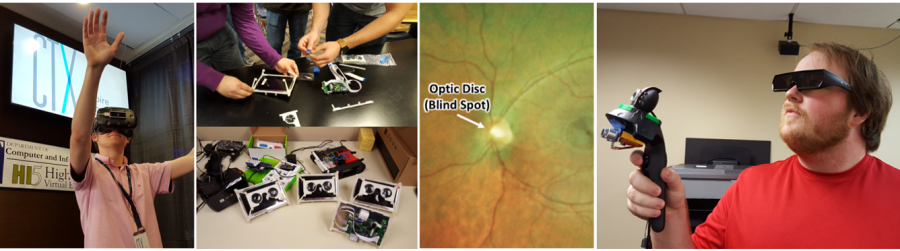
Spiderman VR
High Fidelity Virtual Environments (HI5) Lab
Spiderman has been the Hi5 Lab's most popular demo for the several years I was a part of it. It was debuted at the C-Spire MVMT Technology Experience and has been in main rotation in similar events such as the eSports Eggbowl. Spiderman is a webslinging adventure through flying islands with a tracked body using inverse kinematics.
Change Blindness
High Fidelity Virtual Environments (HI5) Lab
Change Blindness is a senior capstone project for the Hi5 Lab. It takes heavy influence from Dr. Evan Suma Rosenberg who now runs the Illusioneering Lab at the University of Minnesota. This project aims to fool the user into navigating a very large virtual space within a confined physical space. It includes several modes: a top-down version, a VR version, and an FPS style mode with WASD movement and mouse look.
FPS Game
High Fidelity Virtual Environments (HI5) Lab
With the help of Andrew Jelson, we designed and developed a simple Quake-inspired FPS game to showcase Unity3D abilities over a short time. This project demonstrates rapid prototyping and game mechanics implementation.
Dioptic Playground
High Fidelity Virtual Environments (HI5) Lab
The Dioptic Playground is a simple project that can be used as a framework to modify either eye in an HMD in Unity. This was actually quite more difficult than it appears since the majority of HMDs don't want weird and possibly distorting things happening to a user's vision. This project is a brief showcase of what can be achieved as well as a jumping-off point for those interested in vision manipulation studies.
Personality Around the Globe
Class Final Project with Jordan Pyper & Jackson Leach
This project explores data collected across the globe from a psychometric survey totaling over 1 million participants! Our goal was to transform raw data into digestible visualizations for the public. We found many countries are strikingly similar in personality on average. The change in personality across cultures did not come across as apparent as we thought it would be. Finding how similar we all are on the inside while being so diverse on the outside is a great result. We succeeded in wrangling large-scale data and presenting effective visualizations in a clear, engaging way.
The Depth Light
High Fidelity Virtual Environments (HI5) Lab
The Depth Light is an engineering project that accurately places a live webcam video feed at the correct depth within a virtual environment. An ultrasonic sensor measures the real-world distance to a physical object and feeds that value into Unity, which positions the webcam feed at the corresponding depth in the VE. The result is a seamless blending of real and virtual space, where physical objects appear anchored correctly within the virtual world.